Saturday, January 9, 2016

#GreenParty livestream of 2016 State of the Union w/ candidate interviews, viewer chat, Jan 12 | #p2 #the99%


Green Party of the United States
http://www.gp.org

This release is online at http://www.gp.org/greens_will_host_livestream_broadcast_of_sotu

Contacts:
Scott McLarty, Media Coordinator, 202-904-7614, mclarty@greens.org
Starlene Rankin, Media Coordinator, starlene@gp.org


The Green Party will host a livestream broadcast of President Obama's 2016 State of the Union address with Green guest commentary, Tuesday, Jan. 12

• Featuring interviews with Green candidates; viewers invited to participate in the chat during the broadcast

• When: Tuesday, Jan. 12, 9:00 pm ET, 6:00 pm PT

• Where: http://www.youtube.com/user/GreenPartyVideos/live

• Facebook page: https://www.facebook.com/USGreenPartyonLivestream


WASHINGTON, DC -- The Green Party will host a broadcast of President Obama's 2016 State of the Union speech on Tuesday, Jan. 12, featuring interviews with Green candidates for the U.S. Senate and House and an online chat on the Green Party's Livestream channel on YouTube.com (http://www.youtube.com/user/GreenPartyVideos/live).

The State of the Union broadcast, which begins at 9:00 pm ET, will be aired on the livestream page. A chat box for the discussion will be on the screen next to the live State of the Union video.

Among the guests on hand to comment on the President's speech:

• Shamako Noble, candidate for U.S. Senate in California (http://shamako4senate.com)
• Margaret Flowers, candidate for U.S. Senate in Maryland (http://www.flowersforsenate.org)
• Arn Menconi, candidate for U.S. Senate in Colorado (http://arnmenconi.com)
• Matt Funiciello, candidate for U.S. House in New York, 21st Congressional District (http://mattfunicielloforcongress.org)
• Joe DeMare, candidate for U.S. Senate in Ohio (http://www.joedemareforagreenfuture.org)
• Joe Manchik, candidate for U.S. House in Ohio, 12th Congressional District (https://www.facebook.com/manchikengineering)

More guests will be announced soon. The show will be hosted by Andrea Mérida, co-chair of the Green Party of the United States and organizer of the party's Latinx Caucus (http://www.gp.org/caucuses_affinity_groups#latinx).

Viewers are encouraged to contribute questions for the guests, online by chat or by phone. The guests will be on the broadcast via remote webcam on Skype.


MORE INFORMATION

Green Party of the United States http://www.gp.org
202-319-7191
• Green candidate database and campaign information: http://www.gp.org/elections
• News Center http://www.gp.org/newsroom
• Ballot Access Page http://www.gp.org/ballot-access-committee
• Video Page http://www.gp.org/video
• Green Papers http://www.greenpapers.net/
• Google+ https://plus.google.com/communities/102653783893662302489
• Twitter https://twitter.com/greenpartyus
• Livestream Channels http://www.livestream.com/greenpartyus and http://www.youtube.com/user/GreenPartyVideos/live
• Facebook page https://www.facebook.com/GreenPartyUS

Green Pages: The official publication of record of the Green Party of the United States
http://www.greenpagesnews.org

Wednesday, December 30, 2015

Trade deal will lock in high drug prices, hurt seniors | #P2 ##The99% #TheBigPicture #StopTPP


Flush the TPP! Stop the Global Corporate Coup!

        Trade deal will lock in high drug prices, hurt seniors
By Robert Roach, Jr. in The Hill

The United States has concluded negotiations on the Trans Pacific Partnership (TPP) trade deal, and on November 5, 2015, President Obama released the text of the agreement. This started a 90-day period for public review before Congress can take an up or down vote. It is a pact of historic proportions involving 12 countries in Asia and the Americas.

Older Americans should be deeply concerned about this deal. If implemented, TPP will maintain high drug prices for America’s seniors and undermine the sustainability of public health programs like Medicare and Medicaid.

The TPP would enact unprecedented protections for Big Pharma. It would lock in patent exclusivity for biologics – specialty drugs used to treat diseases such as cancer and rheumatoid arthritis. 

Allowing pharmaceutical companies to maintain a monopoly on these drugs before less expensive generic versions can be made by other companies is against the interest of American consumers.

The TPP would also make it easier for pharmaceutical companies to extend patents on drugs in other TPP countries by simply making small changes to the drugs’ formulas or methods of administration – rather than improving their effectiveness, as is currently required.  This practice, called “evergreening,” could delay the introduction of generic brands even further.

Other provisions in the deal could jeopardize the government’s ability to list and price prescription drugs in Medicare by putting the interest of drug and medical device companies above those of taxpayers and beneficiaries. TPP requires that the government agency setting drug polices make available a review process for healthcare reimbursement decisions and to follow TPP rules and principles.  This will grant pharmaceutical and medical device manufacturers the opportunity to contest a decision and seek higher reimbursement rates.

Moreover, corporations could use the Investor State Dispute Settlement process to bypass the U.S. legal system and challenge government measures in a secret, international court if the industry feels certain requirements in TPP are not being met and the government’s policy “unfairly” impacts the company’s expected future profits.

Americans pay the highest prices for prescription drugs in the world.  Last year, drug prices increased by 13 percent, eight times the rate of inflation. High drug prices not only hurt families, they drive up the amount that taxpayers pay to support Medicare and Medicaid, weakening these programs and draining government coffers and the Medicare trust fund.

Bad trade deals have resulted in millions of lost jobs, lower wages, and too much power to corporations over the last 20 years. But there is still time to stop this one. Ratification of TPP is contingent upon a vote in Congress. When that vote occurs, the members of the Alliance for Retired Americans will be paying close attention to what Congress does – and so should anyone else who needs Medicare or prescription drugs.

Roach is president of the Alliance for Retired Americans.  He was previously general secretarytreasurer of the IAMAW.
 
«

Sunday, June 14, 2015

On MONDAY please call your Member of Congress and tell her or him to vote "No" on TAA


PopularResistance.org

Last week, Congress received tens of thousands of phone calls every day from people who are clear which side they are on: they want people and planet before profits; they want an open, transparent democracy not a secretive oligarchy.

The campaign to stop Fast Track for corporate trade agreements like the TPP is a clarifying moment. It is democracy vs. oligarchs making decisions for us. It is transparency vs. secret law. It is the people vs. big business. It is a mobilized people vs. big money. These are the issues that unite people into a movement of movements. These are conflicts that let us know who is on the side of the people.

TAA defeated in the House. By Thomas Hedges of The Real News.

Fast Track victory, but our work is not done

We won an important round last week in the campaign to stop the Obama trade agenda when the House voted against Trade Adjustment Assistance (TAA). Even though they voted for Fast Track (TPA), it is stalled without TAA. In the beginning of next week there will be another challenge when the House reconsiders TAA. Mobilization is more important than ever right now.

Call your member of Congress using StopFastTrack.com or use this spread sheet which contains contact information for all of the Members who voted to stop TAA. Tell them: “No compromise, vote ‘no’ on TAA; people want jobs and a future, not job and climate-killing treaties.”

Two weeks ago, when the vote in the US House of Representatives approached, we began a daily vigil at Congress. When the date of the vote was announced, we began a 24 hour occupation so that no matter when a Member or congressional staff were there, we had a presence. We provided human faces to the tens of thousands of calls they were receiving.

Kelsey Erickson,  Lee Stewart and MacKenzie MacDonald were among those who greeted Members as they went to vote. By Margaret Flowers.
Kelsey Erickson, Lee Stewart and MacKenzie MacDonald were among those who greeted Members as they went to vote. By Margaret Flowers.

On the morning of the vote, we were there greeting Members of Congress as they drove or walked into the Capitol Building for the vote with signs that warned “A Vote for Fast Track Will End Your Career, Remember NAFTA,”  “Voters Will Remember, Vote No on TPA/TAA” and “Vote TPA and You Will Face a Primary.” Congress knew the people were serious and they would pay a political price.

We felt like we had the votes to stop fast track, and then there was a surprise visit from President Obama. He met with the Democratic Party leadership and then with the full Democratic Caucus. Voting was delayed for more than two hours.  Our confidence declined as we wondered whether or not the Democrats would give their president what he wanted. Was the populist pressure enough to convince the Members to say “No” to the president?

We were shocked when the vote on TAA was announced – 302 Members took our side, though we needed only 218 to win. This was a landslide against the president as without TAA, Fast Track could not move forward. As you can see in this video we erupted in emotion, hugged and pumped our fists in the air. It was an amazing moment.

Then the other shocker: the House quickly passed TPA or Fast Track with 219 votes.  This brought confusion. What did it mean? How will this be resolved? The answer – a re-vote on TAA will be held perhaps as early as Monday. Our job is to prevent defections. No doubt President Obama is working to change minds. So it is not over yet.

1g7Why Does Corporate Rigged Global Trade Unite Us?

The fight to stop the TPP and the two other international agreements (TTIP and TiSA) is an opportunity to unite all segments of the movement for social, economic and environmental justice. Last week G7 protesters united in opposition to the Transatlantic trade deal with tens of thousands protesting in the streets. The reaction by the elites was fear, more than 20,000 police were deployed against the G7 protests in Germany. There is a global populist revolt against concentration of power in big business that puts their profits above all else.

As people have gotten to know about these agreements, their opposition has grown stronger. Ralph Nader summarized a lot of the problems when he wrote “10 Reasons The TPP Is Not A ‘Progressive’ Trade Agreement“. Leaks added fuel to the fire. In the last two weeks Wikileaks published documents on two agreements. On the TPP, the leaked text showed Big Pharma using TPP against global health and specifically targeting Medicare.  The other leak was of the much less well known Trade in Services Agreement (TiSA).

These agreements are made worse by the Fast Track law. For example, Paul Ryan added an amendment to block climate deals. Congress put forward a phony veneer of objectives for the negotiations, obviously fake since they have been consistently ignored in previous deals and since the TPP is almost fully negotiated.

1pelOpposition is building on the left and the right as Breitbart and all of the leading conservative talk shows have come out against Fast Track for what they call “ObamaTrade.”  When Democratic Majority Leader, Rep. Nancy Pelosi refused to say whether she supported Obama’s trade agenda, Democratic groups protested her in San Francisco. Pelosi ended up opposing both TAA and Fast Track.

Back in January when pundits were saying that with Obama and Republican leadership uniting, Obama’s trade agenda would move forward with Fast Track, we believed they were wrong. We saw then the broad and diverse uprising that was developing and wrote that the people would stop  corporate trade. We have not fully achieved that goal yet, but success is within reach and we had a major victory last week.

The Fear of Revolt is Evident

This week a billionaire who owns the parent company of Cartier Jewelry admitted at the Financial Times Business of Luxury Summit in Monaco that the prospect of the poor rising up ‘keeps him awake at night.’ He believes such a revolt could be imminent.  People can see how austerity politics is destroying food, water, housing, healthcare, criminal justice, income and wealth among so many other aspects of life.

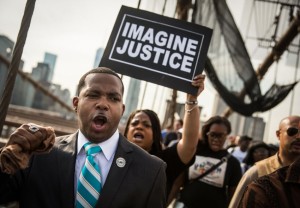
Black Lives Matter Imagine Justice Brooklyn Bridge protest for Eric Garner. Getty Images.And, the elites also see the revolts, whether it is people standing together to defend homeowners facing eviction or foreclosure, or #BlackLivesMatter rightful rage against police violence, or climate justice protesters marching in St. Paul,protesting at a governor’s home in Massachusetts, blocking Shell Arctic drilling or protesting at public meetings. . . every week there are protests like these and more. The elites are aware. They know we are in the midst of revolt.

They fear these protests uniting into a movement of movements as we have seen in the campaign against the Obama trade agenda. They wonder if the upcoming climate talks in Paris will be another Battle of Seattle protest.They know the history of protest makes a difference, just as some this week remembered the ACT UP protests 25 years ago that changed the way the nation dealt with AIDS. 

They also see people uniting like this Summit that brings together 25 Indigenous Nations for resistance, or this activist who describes how he learned how what the power structure called weaknesses were really strengths, e.g. “a sense of solidarity, compassion, a merging of the mind and the body, learning and willing to take risks, embracing passion, connecting knowledge to power, and being attentive to the injuries of others and embracing a sense of social justice.”

1commonsThey also see people talking about the economy as a “commons” where we all benefit and share to build economic and environmental security for all. All of this, and more, adds up to people realizing they have collective power that can overcome the abuse and greed of the extreme wealthy.  Billionaires should have a hard time sleeping at night because, as Chris Hedges writes, the revolt is coming.

We are returning to Capitol Hill Monday to maintain our presence there and continue the work to stop Fast Track. We will start with a big protest to greet Members as they return. Please join us if you can make it to DC. We need to be loud!

If you can’t make it, please call your Member of Congress and tell her or him to vote “No” on TAA.

And please make a donation to Popular Resistance to help cover the costs of this action. CLICK HERE TO DONATE.

We will do all that we can to stop Fast Track and to keep you informed. Follow us on Facebook and on twitter using #RiggedTradeRebellion and #StopFastTrack.

Fast Track protest June 12, 2015 as President Obama went into the House. Source NY Times.

Thursday, June 4, 2015

#Obamacare's big overhead costs to top $270B | The Remedy: #SinglePayerNow

|

CNBC 

That sure is a lot of paper clips.

Obamacare is set to add more than a quarter-of-a-trillion—that's trillion—dollars in extra insurance administrative costs to the U.S. health-care system, according to a new report out Wednesday.

The $273.6 billion in additional insurance overhead represents an average of $1,375 per newly insured person, per year, from 2012 through 2022.

The overhead cost equals a whopping 22.5 percent of the total estimated $2.76 trillion in all federal government spending for the Affordable Care Act programs during that time, according to the authors of the online report on the Health Affairs blog.

In contrast, the federal government's traditional Medicare program has overhead of just 2 percent, according to the report.

Affordable Care Act
Jimmy Anderson | Getty Images
 
"Insuring 25 million additional Americans, as the [Congressional Budget Office] projects the ACA will do, is surely worthwhile," the authors of the Health Affairs blog post write. "But the administrative cost of doing so seems awfully steep, particularly when much cheaper alternatives are available."

The eye-popping Obamacare overhead tally cited by the Health Affairs blog report comes from calculations based on data posted online in July 2014 by the federal Centers for Medicare and Medicaid Services' Office of the Actuary.

Dr. Steffie Woolhandler told CNBC that she and her blog co-author Dr. David Himmelstein only became aware of the projected spending data earlier this year. Their blog said this data allowed "calculation of the incremental insurance overhead costs directly attributable the reform."

But subsequent postings of National Health Expenditure Projections by CMS no longer include separate tables projecting costs with and without the ACA, the blog post noted.

Read More Florida Medicaid showdown getsmurkier

"I am pretty sure we're the first we're bringing it to light," said Woolhandler, who like Himmelstein is a City University of New York School of Public Health professor as well as a lecturer in medicine at Harvard Medical School. "This is the first time there's been a number, and it's a pretty shocking number."

"We're seeing 22 percent of federal spending on the program is actually going to be eaten up by bureaucracy," she said.

A CMS spokesman had no comment when CNBC asked about the blog post.

The large amount of spending devoted to administrative costs both in dollar terms and as a percentage of total ACA spending is a reflection of Obamacare's "use of private health insurance for0 most of the coverage expansion," said Woolhandler. Private insurance, she said, is "associated with high overhead costs."

"The national average is about 13 percent," Woolhandler said.

Her blog post noted that $172.2 billion, nearly two-thirds of total new ACA overhead spending, "will go for increased private insurance overhead," in the form of insurers' administrative costs and profits.
The remaining administrative overhead is due mainly to government programs, primarily from the cost of expanding Medicaid benefit coverage to previously ineligible poor adults, the blog post said.

Read More Price worries persist for Obamacare market plans

"But even the added dollars to administer Medicaid will flow mostly to private Medicaid HMOs [health maintenance organizations]," the blog said.

"Traditional Medicare is a bargain compared to the ACA strategy of filtering most of the new dollars through private insurers and private HMOs that subcontract for much of the new Medicaid coverage," the blog said. "Indeed, dropping the overhead figure from 22.5 percent to traditional Medicare's 2 percent would save $249.3 billion by 2022."

Obamacare is designed to expand health coverage in three primary ways: the sale of private insurance plans on government-run marketplaces, with federal financial assistance available to most customers; allowing more poor adults to qualify for Medicaid than before; and allowing people under age 26 to stay on their parents'private insurance plans.

Woolhandler, like Himmelstein, is a proponent of a single-payer health system that would have the federal government insure all Americans. Both are co-founders of a leading advocacy group for that goal, Physicians for a National Health Program.

A single-payer system was not seriously debated in Congress before the implementation of the ACA. But advocates for such a scheme had argued that it would give "a bigger bang for your buck" than expanding coverage primarily through the use of private insurance, Woolhandler noted.

Read MoreMedical cost inflation at 8-year high

But until the CMS data came to light, she said, advocates could not point to official estimates of how much Obamacare would actually cost in terms of administrative overhead. If such an estimate had been available, it might have helped sway Congress to save the so-called public option for the ACA, she said.

The public option would have involved the government offering its own insurance coverage as one of the options for customers of government-run Obamacare exchanges, which currently offer only private insurance plans. The public option ended up being removed from the final ACA bill voted upon by Congress.

Woolhandler said she expects the public option, like Medicare, would have had much lower overhead costs than private insurance.

She also said that the massive amount of money that will be spent on administrative overhead in Obamacare hobbles the law's stated goal of providing expanded, affordable coverage to uninsured Americans.

"You're getting less of it if you're covering 22 percent in overhead," she said.

If the program had much lower administrative overhead costs, then people insured under the ACA could have lower co-payment and deductibles as part of their insurance, she said.

Those costs, which a customer must personally pay out of their pocket before their plan covers a medical service, can lead people to avoid seeking health care because of financial concerns, Woolhandler said.

Thursday, April 23, 2015

#YouNeedToKnow #Politics #Election2016: Hillary Won't Save Us, Neither Will Bernie or Liz | #ows #p2 #The99%


21st-century time bombs like global warming require a drastic change in the U.S. political landscape     

By Scott McLarty     
OpEdNews.com     

March 31 news item: President Obama's Interior Department has approved leases for high-risk oil drilling in the fragile Arctic waters of the Chukchi Sea north of the Bering Strait (http://earthjustice.org/news/press/2015/department-of-the-interior-opens-gate-for-risky-oil-drilling-in-the-arctic-s-chukchi-sea).     

Interior's rush approval, overriding an earlier ruling from the Ninth Circuit Court of Appeals, should remind us of the inconsistencies in the President's 2015 State of the Union speech. On one hand, a declared commitment to fight global warming. On the other hand, a call to develop more domestic fossil-fuel sources.     

Hillary Clinton, the current best bet for the Democratic Party's nomination in 2016, is likely to show even less concern for the climate crisis (http://www.motherjones.com/environment/2014/09/hillary-clinton-fracking-shale-state-department-chevron), if elected.     

For this reason and others, many Democrats are urging Senators Bernie Sanders and Elizabeth Warren to compete with Ms. Clinton for the nomination. Even if Mr. Sanders or Ms. Warren can't beat Ms. Clinton in the primaries, they'll push her to the left. Right?     

Any progressive Dem who runs in 2016 will have the same negligible effect as Jesse Jackson and Dennis Kucinich in previous elections.     

It's no longer reasonable to believe that the Democratic Party can be rescued from its war-and-Wall-Street leadership and addiction to corporate campaign checks.     

The likely scenario is that Ms. Clinton will draw post-nomination progressive support that's based either on delusion ("Deep in her heart, Hillary is really one of us!") or less-of-two-evils resignation ("We must keeping voting D to prevent an R victory!"), with a generous helping of enthusiasm for a possible first woman president. By the time the Democratic National Convention rolls around in mid 2016, Ms. Warren and Mr. Sanders will be as marginal as Mr. Kucinich was during past Dem conventions.     

How long do progressives intend to participate in their own self-defeat? Or, more to the point, how long before progressives admit that Dems are as incapable as Repubs in addressing the major crises we face during the remainder of the 21st century?     

The crises can be summarized: (1) a looming global climate catastrophe; (2) a new Robber Baron economy under which the One Percent are amassing unprecedented wealth and power while they dismantle the public sector, the social safety net, and financial security for working people, with a small group of large corporations functioning as an unelected government; (3) a growing national-security/mass-incarceration state, which includes universal surveillance, the for-profit prison-industrial and homeland-security feeding troughs, runaway police and prosecutorial power, and appalling racial disparities in arrests and sentencing; and (4) a neocon doctrine of military power under which the U.S. may unilaterally attack any nation at will to assert political hegemony and control over resources.     

The combination of these four crises promises an era of deteriorating quality of life, increasing debt, eroded rights and freedoms, lawless militarism, and (if global warming forecasts are correct) the danger of complete social breakdown. Their severity can be compared with the rise of totalitarian states and the Cold War's nuclear menace during the 20th century.     

Progressives like to say that "another world is possible." Another world won't happen by investing hopes in Democratic also-rans. Progressives have been pledging to rehabilitate the Democratic Party for decades. They've gotten nowhere. President Obama stacked his top-level staff from the beginning with former Wall Street execs and his economic policies are to the right of Eisenhower's and Nixon's. Democrats like to boast about a post-2008 economic recovery. The fact that 95% of the recovery's gains went to the top One Percent suggests that Dems have embraced the Reagan-era trickle-down theory.     
 
Despite their obvious differences, the Democratic and Republican parties are both on the wrong side of this century's major crises. The two parties are driving us in the same direction. The lesser-evil rationale is simply a wager that the GOP will drive us off the cliff a few years earlier.     

Two-Party Symbiosis     

Comedian Lewis Black once said that Republicans are the party of bad ideas and Democrats are the party of no ideas. He might have added that gullible people can be inspired by bad ideas, while no one is inspired by no ideas. (Hence the Republican takeover of Congress in the 2014 midterm elections.) Dems are right about the GOP's descent into irrationality and fanaticism, illustrated recently by the letter from 47 Republican U.S. senators to Iran's leaders, prohibitions on Florida and Wisconsin government employees from mentioning climate change, and frothing condemnations of same-sex marriage rights.     

But decrying extremism and warning us about Republican appointees to the Supreme Court aren't the same as offering a persuasive alternative.     

The GOP has been successful in part because the Democratic Party, ever since President Carter's retreat from labor and Clintonian triangulation, has been unable to present a grand populist vision comparable to President Roosevelt's New Deal and President Johnson's Great Society. "Bridge to the 21st Century" and "Hope and Change" were never more than slogans. Centrist and moderate Dems have embraced Robber-Baron agenda like privatization, deregulation, free-trade deals that favor the corporate sector, and crushing public-sector unions. (Centrism and moderacy should be understood as a species of extremism: the middle point at which Dems and Repubs overlap on the political spectrum is where both parties are most loyal to their corporate sponsors.)     

"Everyday Americans need a champion and I want to be that champion," said Hillary Clinton when she announced her candidacy on April 12. A populist program introduced by Hillary Clinton, darling of Goldman Sachs, would be only slightly less unconvincing than one from a Republican.     

Behind the intense partisan enmity and Capitol Hill gridlock is a symbiosis. Democrats appear rational and moderate in comparison with the GOP. Republicans look like fearless leaders in comparison with visionless, compromising Dems, while the rightward slide of the Democratic Party has enabled a Republican brand of politics based on a synthesis of John Birch, Ayn Rand, and Gen. Augusto Pinochet. (A similar dynamic is at work within the two parties: Ted Cruz makes Jeb Bush look sane.)     

It's foolish to believe that the steps necessary to defuse the four crises I listed above will come from one of the two corporate-money parties. For anyone concerned about our own well-being, future generations, and the health of the planet, these crises must inform the 2016 election, especially when the window is closing on what we can do to prevent the melting of Arctic ice sheets and rising sea levels.     

The only thing that can arrest the unfolding emergencies of the 21st century is a drastic change in the political landscape. Aside from outright revolution, changing the landscape is only possible through an aggressive and sustained third-party insurgence.     
 
The Third-Party Imperative     

Most of the Left gets squeamish at the thought of third parties. Mainstream progressive and ecological groups and unions remain joined at the hip with the Democratic Party. Even when Left commentators denounce Dems and pine for alternatives, they retreat into lesser-evil apologies: "I’ll have to vote for Hillary, like everyone else. I just choose not to revel in the ugly, doomed necessity of it." ("Don't be less evil," MaxSpeak, March 27, 2015,  http://maxspeak.net/dont-be-less-evil). This tendency parallels the popular wish, expressed regularly in polls (e.g., http://www.gallup.com/poll/165392/perceived-need-third-party-reaches-new-high.aspx), for more parties that disappears every Election Day when voters endorse the two established parties and reelect incumbents.     

Adolph Reed Jr., in "Nothing Left: The long, slow surrender of American liberals" (Harper's, March 2014, http://harpers.org/archive/2014/03/nothing-left-2), laments the failure of a third party to take hold and closes with a call for movement-building: "The crucial tasks for a committed left in the United States now are to admit that no politically effective force exists and to begin trying to create one. This is a long-term effort, and one that requires grounding in a vibrant labor movement."     

Movements need an electoral counterpart. In the U.S., movements tend to exist in fits and starts. The only lesson President Obama learned from the anti-globalization movement that erupted in Seattle sixteen years ago was that the Trans-Pacific Partnership should be negotiated in secret. President Bush simply ignored the anti-war movement, which nearly evaporated after the 2008 election. Occupy Wall Street hardly scratched the surface of the nation's economic status quo: the modest financial-sector reforms of the 2010 Dodd-Frank Act were weakened further when last year's budget bill enacted public insurance for high-risk derivatives trading, with Mr. Obama's support. Thanks to the Supreme Court's Citizens United ruling, the One Percent remains stronger than ever.     

The Populists, Eugene Debs and his fellow Socialists, and others who organized a century ago understood the importance of alternative parties in sustaining popular movements. Even when the parties failed to achieve permanence, they profoundly altered the landscape.     

The legacy of third parties in the U.S. includes abolition of slavery, women's suffrage, the eight-hour workday, workers' benefits, public schools, unemployment compensation, the minimum wage, child labor laws, direct election of senators, and programs like Social Security and Medicare. All of these were introduced by third parties and adopted later by one or both of the major parties.     

The near-disappearance of third parties on the left in the second half of the 20th century is one of the great unmentioned reasons for the triumph of the right wing in both major parties. Democrats assumed, correctly, that they'd continue to enjoy progressive support regardless of their actions. Progressive votes could simply be taken for granted.     

Democrats shudder at the notion of competition from a progressive third party. They've even created phony alternatives like the Working Families Party to keep progressives inside the Democratic fold. In New York's 2014 gubernatorial race, the WFP endorsed Wall Street errand-boy Andrew Cuomo, a Dem incumbent who urged austerity and worked hard to dismantle the rights of public-sector employees, over Green candidate Howie Hawkins (https://www.jacobinmag.com/2014/07/more-than-a-protest-vote/).     

Revulsion towards third parties accounts for spoiler panic and for Democratic collusion with Republicans in passing grossly unfair state ballot-access rules that privilege major-party candidates and hinder third parties. The post-2000 spoiler accusation allowed Dems to blame Green nominee Ralph Nader for George W. Bush's entry into the White House while ignoring factors like vote obstruction by Florida Republicans, Al Gore's failure to insist on a statewide recount, a patently biased Supreme Court ruling, and confirmation of Mr. Bush's "victory" by Democratic senators.     

The principle behind spoiler panic is that election theft by a major party is more acceptable than election participation by a minor party.     

Democratic apologists like to call third parties an exercise in making the perfect the enemy of the good. Rejecting the lesser of two evils isn't a demand for perfection or purity, it's a desire for an overdue alternative. It's a recognition that Americans deserve the right to vote for a candidate who best represents their interests and ideals, without being told that only two candidates are legitimate.     

Shortly after her election to Seattle City Council in 2014, Kshama Sawant of Socialist Alternative succeeded in getting a $15 livable-wage bill passed. In Richmond, California, Green Mayor Gayle McLaughlin enraged Wall Street by using eminent domain to rescue residents facing foreclosure from losing their homes. (President Obama still refuses to demand foreclosure relief from the same bailed-out banks whose reckless greed triggered the 2008 meltdown: http://www.salon.com/2015/03/31/barney_frank_drops_a_bombshell_how_a_shocking_anecdote_explains_the_financial_crisis). These local victories demonstrate what's possible when third-party candidates get elected.     

The crises of the 21st century require analogous actions at the national level. 2012 Green presidential nominee Jill Stein, Mr. Hawkins, and other Greens have promoted the "Green New Deal," a comprehensive plan to create millions of new jobs through public investment and projects to end fossil-fuel consumption (http://www.gp.org/GreenNewDeal). ;     

The Green New Deal would enact a single-payer national health care system and forgive student loan debts. Instead of austerity, the bipartisan policy whereby working Americans are punished for the criminal excesses of Wall Street behemoths, the Green New Deal would break up too-big-to-fail banks. It recognizes that the climate crisis can only be solved by national and international efforts comparable to the cooperation among the Allies that defeated the Axis powers in World War II.     

The most surprising part of the Green New Deal is that so many of its planks echo Progressive Era and New Deal agenda of the last century and current policies in many European nations. They're hardly radical at all, except in comparison to today's Democratic and Republican parties.     

Whether they're radical or not is besides the point. What matters is that such ideas are imperative for the 21st century, if we wish to avert an array of environmental and economic breakdowns, and that they require concerted action in the electoral arena that's independent of the two Titanic parties.     

Scott McLarty is national media coordinator for the Green Party of the United States (http://www.gp.org). He lives in Washington, D.C.     
 

Thursday, March 26, 2015

#TPP will provide a pathway to infect the world’s health systems w/ the deadly parasite of forprofit health corps

The Trans-Pacific Partnership (TPP) is a deal that is being secretly negotiated by the White House, with help from more than 600 corporate advisors, and Pacific Rim nations including Vietnam, Malaysia, Singapore, Brunei, Chile, Peru, Australia and New Zealand. While the TPP is being called a trade agreement, the United States already has trade agreements covering 90 percent of the GDP of the countries involved in the talks. Instead, the TPP is a major power grab by large corporations.
 
The text of the TPP includes 29 chapters, only five of which concern trade. The remaining chapters are focused on changes that multinational corporations have not been able to pass in Congress such as restrictions on internet privacy, increased patent protections, greater access to litigation and further financial deregulation.
 
So far, all that is known about the contents of the TPP is from documents that have been leaked and reports from non-governmental organizations and industry meetings. Unlike other trade deals, the White House refuses to make the text available to the public. In fact, the negotiators refuse to publish the text until four years after it is signed into law.
 
From the information available, one thing is clear about the impacts of the TPP on health care. The intention of the TPP is to enhance and protect the profits of medical and pharmaceutical corporations without regard for the harmful effects their policies will have on human health.
 
We know that the TPP will extend pharmaceutical and medical device patents and provide other tools to keep the prices of these necessities high. This will make medications and treatments unaffordable for millions of people and raise the costs of national health programs, including public health systems in the U.S.. At its worst, the TPP will provide a pathway to infect the world’s health systems with the deadly parasite of for-profit health corporations that plague the United States.
 
The major health threats posed by the TPP include:
 
  • Extensive patent protections. Through the TPP, pharmaceutical and medical device corporations are seeking extensive patent protections using a process known as ‘Evergreening.’ The TPP gives twenty years of patent protection for pharmaceuticals and medical devices; however, patents can be renewed for another twenty years each time there is a change in an indication or delivery. 
    • Doctors without Borders criticized this practice, stating that patent protections in previous trade agreements raised the price of life-saving medications and made them unavailable to people in poorer countries. Patents prevent the production of low cost generic forms of medications. 
    • Because of the negative impact on public health from patent protections in previous trade agreements, such as the Korea Free Trade Agreement, former President Bush rolled some of these practices back. Unfortunately, the TPP will move them forward again. In fact, the TPP goes farther to require patents on surgical techniques, medical tests and treatments.
  • Prevention of necessary innovation. Doctors without Borders also expressed concern that patent protections encourage innovation based on profit instead of on the needs of people, particularly those in poor nations. Corporations do not see it as in their financial interest to address health conditions more prevalent in poor nations which do not have the financial resources to buy their products. But it is often in these situations where treatment can have the greatest impact on quality of life.
  • Attack on public health systems. An area of great concern is language within the TPP concerning State-Owned Enterprises (SOEs). These are institutions that are fully or partially owned by governments, which could include public health systems.
    • Corporate lobbyists are concerned that SOEs have ‘unfair advantages’ over private industry. These advantages include government subsidies, preferred tax status, low finance rates and access to capital. According to a leaked chapter, corporate lobbyists believe that there is a conflict of interest because SOEs have political considerations such as functioning to provide basic goods and services for their population and believe that instead SOEs should operate strictly as commercial entities.
    • The TPP requires SOEs to disclose any special advantages they receive and the government to give the same advantages to corporations. It also provides methods for corporations to sue governments if they believe that they are not being treated fairly.
    • Text from a section of the TPP called “Annex on Transparency and Procedural Fairness for Healthcare Technologies” was leaked in June, 2011. It reveals that medical industries are pushing on all fronts to keep their prices and prevent public health systems from negotiating to keep prices affordable. To medical industries, price negotiation is one of the ‘unfair advantages’ of public health systems. When a public health system negotiates a lower price, it is said to be exerting its market power. On the flip side, when a government extends patent protections to medical industries, this is not considered to be a use of market power by the industry.
  • Greater control over reimbursement. Medical industries are pushing for other concessions within the TPP to ‘level the playing field,” also known as forcing public entities to operate as market-based entities, such as factoring the cost of not just research, development and production of drugs and medical devices but also the cost of marketing them into what is considered to be a fair market price. And they only view prices negotiated without any government influence as fair. These provisions are significant because the TPP allows pharmaceutical corporations and others to challenge the legitimacy of any reimbursement decisions made by public health systems through the courts.

    • Patent and price protections for multinational pharmaceutical and medical device corporations based in the U.S. will benefit their bottom line and their investor’s pockets, but may bounce back and undermine public health systems in the U.S.. The leaked text indicates that the above provisions only apply to health authorities under the jurisdiction of the federal government. However, the loop holes are large enough that all of the U.S. public health systems, which include Medicare, Medicaid, Tricare and the Veterans Health Administration, can arguably be considered to be federal.
To solve the health crisis in the U.S., we must move away from privatization of health care and towards a public health system with a mission to improve and protect the health of the public.

Therefore, the Health Council of the Green Shadow Cabinet opposes provisions within the TransPacific Partnership that make profit more important than public health. We oppose all provisions that restrict access to necessary medications, medical tests and treatments. Rather than the expansion of patent protections, there should be increased sharing of medical knowledge to promote improved global public health.

~ The Health Council is led by Secretary of Health Dr. Margaret Flowers, serving within the General Welfare Branch of the Green Shadow Cabinet.  This statement is one of over a dozen issued in support of the Green Shadow Cabinet's June 17th call for action against the TPP.

Tuesday, March 10, 2015

#SinglePayer's #universalcoverage would resolve problems caused by #Obamacare & #forprofit #insurance #bureaucracy


Green Party of the United States

For Immediate Release:
Tuesday, March 10, 2015

Contacts:
Scott McLarty, Media Coordinator, 202-904-7614, mclarty@greens.org
Starlene Rankin, Media Coordinator, 916-995-3805, starlene@gp.org

Green Party: Flaws in Obamacare exposed by King v. Burwell Supreme Court case should motivate new demand for a Single-Payer national health program     

• Greens warn that an adverse ruling by the Supreme Court would cancel health coverage for millions and drive up premiums for policyholders

• Single-Payer's universal coverage would resolve problems caused by Obamacare and for-profit insurance bureaucracy, say Greens

 
WASHINGTON, D.C. -- Green Party leaders expressed hope that King v. Burwell, now under review by the U.S. Supreme Court, would be decided against the plaintiffs, since the law suit threatens more than 8 million Americans with the loss of their health insurance, but also stressed the continuing need for a Single-Payer national health care program (Medicare For All).
    
"Greens still advocate for Single-Payer to replace an expensive and wasteful system that favors private insurance company profits​. King v. Burwell has exposed and spotlighted the bureaucratic complexities and flaws in the Affordable Care Act. Nonetheless the system is better than what we have had and should not be dismantled causing further increases in the disenfranchisement of people in our country who need to be assured that their medical issues will be attended to," said Darryl!l L.C. Moch, co-chair of the Green Party of the United States.     
 
"If the federal government can provide for its employees, Congress, and the President, including former Presidents and first families, then that same system should be good enough and available to the American public," said Mr. Moch.     

"The Green Party supports Medicare For All and opposed Obamacare, because we believe a health care system should guarantee all Americans high-quality, low-cost medical care rather than sustain the health insurance industry. But we don't want people to lose the coverage they currently receive through federal exchanges under Obamacare. The Competitive Enterprise Institute and Republican politicians who support the suit aren't concerned about the tens of millions of Americans who lack coverage or the millions more who might lose coverage. It's clear that they're bent on dismantling Obamacare for political purposes," said John Battista, MD, former Green candidate for state representative in Connecticut and co-author of his state's single-payer legislation in 1999 (Connecticut Health Care Security Act).     
 
The challengers in King v. Burwell filed their suit after lawyers hired by the Competitive Enterprise Institute scoured the text of the ACA and discovered an inconsistency that seems to limit federal subsidies to those who purchase coverage on state exchanges, contrary to provisions in the rest of the legislation.     

The effect of the suit, if the court decides in favor of the plaintiffs, would be revocation of subsidies for millions of middle- and low-income people who live in the 34 states that have chosen not to establish exchanges. Cancellation of the subsidies would also lead to skyrocketing rates for policyholders who don't depend on federal help (the "ACA death spiral").     

"The current Supreme Court case should motivate Americans who want a better, less expensive health care system to demand Medicare For All. Obamacare balanced its modest reforms and regulations on insurance companies with the individual mandate, which ensured a financial windfall for the health insurance industry. It was clear all along that the debate over health-care reform was rigged. Democrats and Republicans disagreed on specifics but agreed on the premise that accommodating insurance companies and other health-care corporations was more important than providing universal health care," said Carl Romanelli, Pennsylvania Green Party member and former U.S. Senate candidate.     

According to a press release from Physicians for a National Health Program (PNHP) published on March 3, "Regardless of how the court rules, the unfortunate reality is that the ACA won’t be able to achieve universal coverage. It won’t make care affordable or protect people from medical bankruptcy. Nor will it be able to control costs. The ACA is fundamentally flawed in these respects because, by design, it perpetuates the central role of the private insurance industry and other corporate and for-profit interests (e.g. Big Pharma) in U.S. health care. In contrast, a single-payer system -- an improved Medicare for All -- would achieve truly universal care, affordability, and effective cost control. It would be simple to administer, saving approximately $400 billion annually by slashing the administrative bloat in our private-insurance-based system. That money would be redirected to clinical care. Copays and deductibles would be eliminated." (http://pnhp.org/blog/2015/03/03/pnhp-release-on-king-v-burwell/)     

Greens noted that the insurance industry contributed millions of dollars to presidential and congressional candidates of both major parties in 2008 (https://www.opensecrets.org/industries/recips.php?ind=F09&cycle=2008&recipdetail=A&sortorder=U), buying influence that resulted in Single-Payer being declared "off the table" when Sen. Max Baucus (D-Mont.), chair of the Senate Committee on Finance at the time, convened health-care reform panels in 2009.     

"We need a health care system that's based on the legally sound precedent provided by Social Security, expanding Medicare to cover everyone regardless of age, employment, ability to pay, and prior medical condition," said Sanda Everette, former co-chair of the Green Party of the United States and co-chair of the Green Party of California. "Single-Payer would allow full choice of physician and hospital and drastically reduce paperwork. It would end the control over our medical care by private insurance bureaucracies that decree which physicians and hospitals we can visit and boost their profits by restricting and denying needed medical treatment. It would stimulate the economy by relieving businesses of the health-care benefit burden. Single-payer is part of the Green New Deal (http://www.gp.org/GreenNewDeal) that Green candidates have been advocating in their campaigns for public office."     

See also:     

The ACA and America’s Health-Care Mess     
By Dr. Gerald Freidman, Dollars & Sense: Real World Economics, January/February 2014

How Obamacare is Unsustainable: Why We Need a SIngle-Payer Solution For All Americans     
Book by John Geyman, M.D., Copernicus Healthcare, January 2015, 328 pages